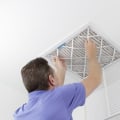
Pick up a recycled-content 12x36x4 air filter, and the cardboard frame in your hand probably started life as a shipping box. The fiber that catches dust and dander came from post-consumer plastic bottles, respun into recycled polyester (rPET) and pleated to fit your HVAC cabinet. These filters work, and after more than ten years of building custom sizes for homeowners across the country, we can tell you exactly what qualifies as recycled, what doesn't, and where the eco-claim still falls short. If you want the air filter basics first, start there, then come back.
TL;DR Quick Answers
Recycled 12x36x4 filters are widely available.
The recycled content sits in the cardboard frame and the rPET fiber media.
Performance matches virgin-material filters at the same MERV rating.
MERV 13 is what most homes should run.
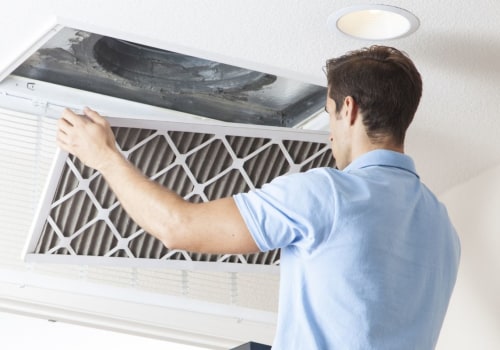
Plan on replacing a 4-inch filter every 3 to 6 months.
Used filters normally go in the trash, not the recycling bin. Seal them first.
Buy from custom manufacturers willing to specify what is recycled and at what percentage.
Top Takeaways
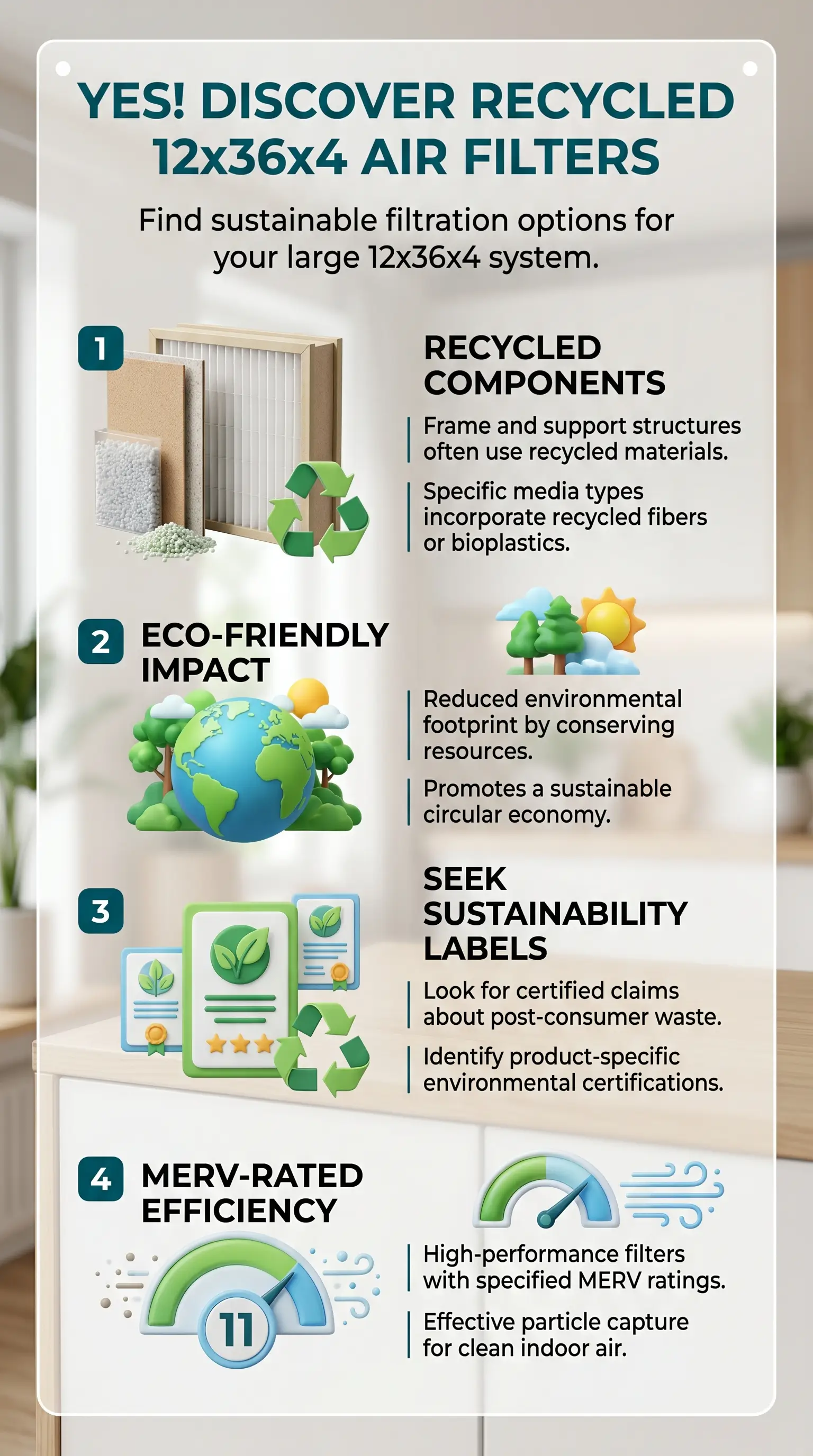
Recycled-content 12x36x4 air filters are available now, usually built with cardboard frames and rPET (recycled polyester) fiber media.
Performance is equivalent. A MERV 11 or MERV 13 recycled filter catches the same particles as its virgin-material counterpart.
"Recycled" almost never means the whole filter. Ask manufacturers which components are recycled, and at what percentage.
Custom sizes like 12x36x4 are ideal candidates for eco-friendly builds. Made-to-order means less overproduction waste.
End-of-life recycling is still limited. Used filters are contaminated and can't go in curbside bins. Seal and trash them.
The biggest eco-choice is still the basics: right size, right MERV, changed on schedule.
What Counts as a "Recycled" 12x36x4 Air Filter?
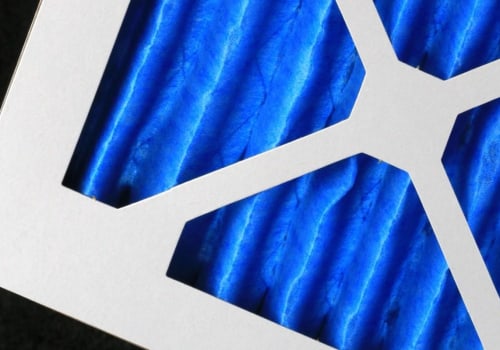
When a 12x36x4 filter gets labeled "recycled," the label almost never covers the whole filter. It covers one or two parts. A standard furnace filter guide will tell you every filter has a frame, media, and packaging. On eco-friendly 12x36x4 air filters builds, recycled content shows up in three places: the cardboard or kraft paper frame, the rPET fiber that manufacturers respin from old plastic bottles into filter media, and the corrugate packaging the filter ships in. The dust-capturing layer in most higher-MERV pleated filter options still relies on virgin synthetic fibers. Electrostatic charge and particle-capture performance are hard to match with 100% recycled inputs, so manufacturers leave that layer alone.
Why the 12x36x4 Size Is a Special Case
12x36x4 is not a standard filter size. It runs in high-capacity media cabinets on bigger HVAC systems, and because manufacturers cut it to order instead of mass-producing it on a standard line, the size lends itself to eco-friendly builds. Shops that specialize in custom filter options can source recycled frame stock, spec rPET media, and make only what a customer orders. Less overproduction waste, fewer returns, fewer filters sitting in a warehouse.
Thicker filters also last longer, which matters for sustainability. A 4-inch filter typically runs 3 to 6 months before needing a swap. That is why 4-inch filter options show up more often in eco-conscious homes than 1-inch filters, which you replace every month or two. If you want the technical background on how air filters work, the mechanics of media, airflow, and particle capture go back decades.
Do Recycled 12x36x4 Filters Actually Work?
Yes, they work. In over a decade of testing and shipping custom filters, we have not seen a recycled-content 12x36x4 underperform its virgin-material counterpart at the same MERV rating. If MERV rating basics are still a little fuzzy, the rating tells you what particle sizes a filter catches. A recycled-content filter in MERV 8 options or dust defense filters catches the same pollen, dust, and pet dander as any other MERV 8. Step up to MERV 13 options, and you get the same fine-particle capture as any other MERV 13, including bacteria and smoke particles. The recycled content is in the frame and the structural fibers. It is not in the dust-capture layer, which is where filtration actually happens.
Where Recycled Content Falls Short
The story is not perfect. Fully biodegradable 12x36x4 filters are still rare, and once a filter has held a few months of dust, pet dander, mold spores, and bacteria, it becomes a contaminated product. Curbside recycling programs will not take it. There is also the question of filter change frequency. A "green" filter that needs replacing twice as often burns any carbon savings the recycled frame earned. For homeowners looking at comparable size options or smaller filter comparisons, the same principle applies: service life beats the marketing story. The recycled claim is stronger on what goes into making the filter than on what happens after you pull the used one out of the cabinet. The industry is still working on that side.
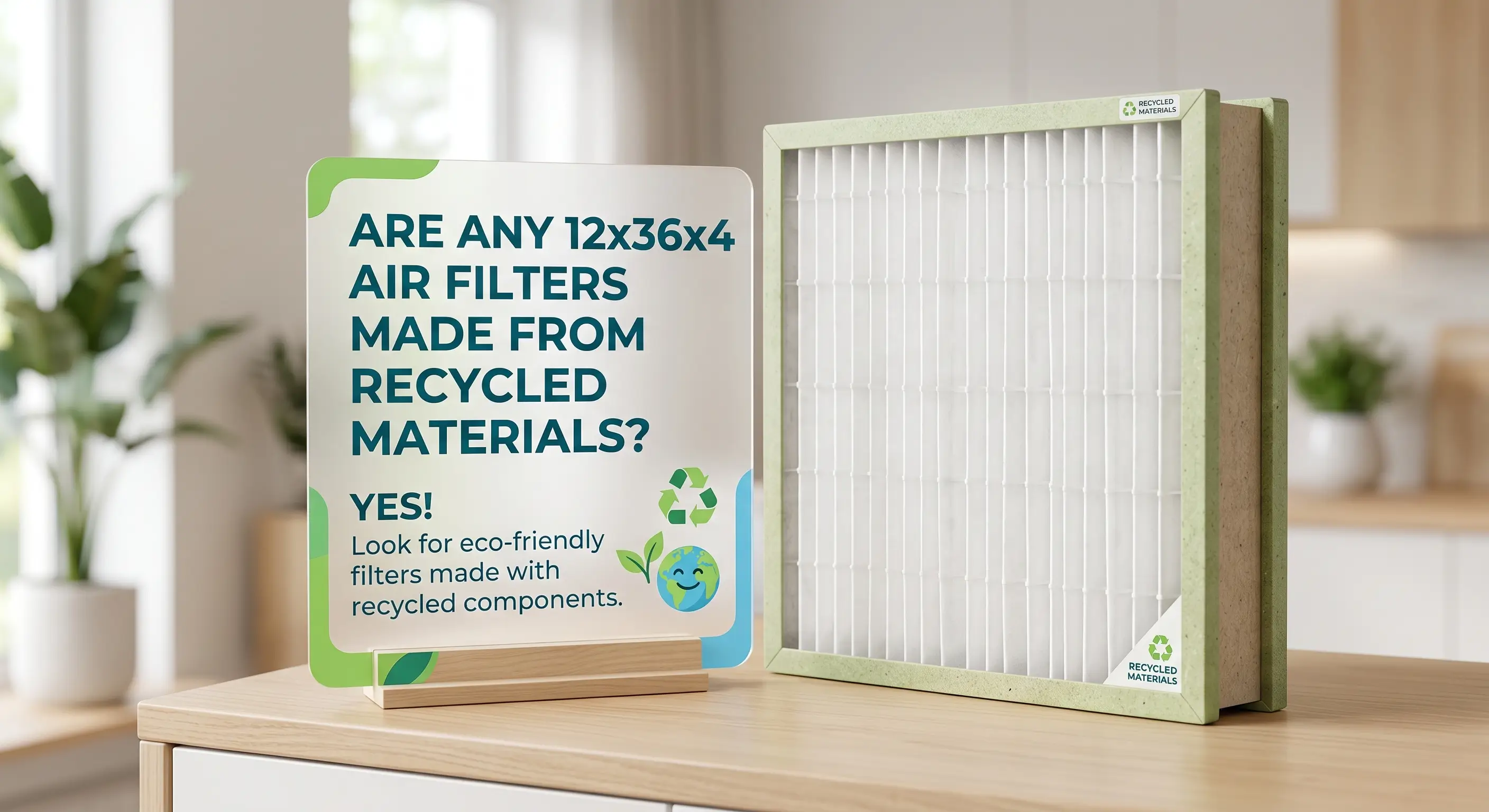
"In over a decade of building custom air filters, we have not seen a recycled-content 12x36x4 perform any differently than a virgin-material one at the same MERV rating. The better question to ask a manufacturer is which components are actually recycled, and at what percentage of the total filter."
7 Essential Resources
The following sources cover air filter materials, indoor air quality standards, and sustainable filtration practices.
EPA — The Inside Story: A Guide to Indoor Air Quality: https://www.epa.gov/indoor-air-quality-iaq/inside-story-guide-indoor-air-quality
ASHRAE — Standards body behind the MERV rating system (ANSI/ASHRAE Standard 52.2): https://www.ashrae.org/
American Lung Association — Air Cleaning and Filtration: https://www.lung.org/clean-air/indoor-air/protecting-from-air-pollution/air-cleaning
NIEHS — Indoor Air Quality Research: https://www.niehs.nih.gov/health/topics/agents/indoor-air
U.S. Department of Energy — HVAC System Operation and Filter Maintenance: https://www.energy.gov/energysaver/operating-and-maintaining-your-heat-pump
ENERGY STAR — Heat & Cool Efficiently (filter change guidance): https://www.energystar.gov/saveathome/heating-cooling
Wikipedia — Air Filter (materials, construction, standards): https://en.wikipedia.org/wiki/Air_filter
3 Statistics Worth Knowing
Americans spend roughly 90% of their time indoors, where pollutant concentrations often run 2 to 5 times higher than outdoor levels. That makes the filter in your HVAC system one of the more consequential sustainability choices in the house. Source: U.S. EPA — Indoor Air Quality
More than 250 million single-use residential HVAC air filters end up in North American landfills each year, with the average household replacing 3 to 4 filters per cabinet slot annually. Source: Cycle Air — Are Furnace Filters Recyclable?
HEPA filters can remove at least 99.97% of dust, pollen, mold, bacteria, and other airborne particles at 0.3 microns, the most penetrating particle size. High-performance filtration and recycled-content construction are not mutually exclusive. Source: U.S. EPA — What is a HEPA Filter?
Final Thoughts and Opinion
Our honest read on this: the question of whether recycled-content 12x36x4 filters exist is settled. They do, and they work. The better question is which components carry the recycled content, and whether that changes how well the filter protects your family. Our answer to the second part, after a decade of making these filters, is almost always no. A well-built recycled-content 12x36x4 matches a virgin-material filter at the same MERV rating.
Where we push back on the industry, ourselves included, is on what happens after the filter comes out. A closed-loop system for used residential filters does not really exist yet. Until it does, the most meaningful eco-move a homeowner can make is choosing the right size, running the highest MERV rating the system allows, replacing on schedule, and buying from manufacturers willing to say exactly what is recycled and what is not. "Green" marketing without those specifics is just marketing.
Frequently Asked Questions
Are 12x36x4 air filters with recycled materials as effective as standard filters?
Yes. At the same MERV rating, a recycled-content 12x36x4 filter catches the same particles as one made from virgin materials: pollen, dust, pet dander, mold spores, and fine particulates. The recycled content is in the frame and the structural fibers, not in the layer that does the actual filtration.
What MERV ratings are available in eco-friendly 12x36x4 filters?
Recycled-content 12x36x4 filters typically ship in MERV 8, MERV 11, and MERV 13. Most health authorities, including the EPA, recommend MERV 13 for residential HVAC systems because it captures fine particles at the size of many bacteria and smoke particles.
How often should I replace a 12x36x4 air filter?
Most 4-inch filters, 12x36x4 included, run 3 to 6 months. Homes with pets, allergies, wildfire smoke exposure, or heavy HVAC use should lean toward the 3-month end. Change on schedule. A clogged filter wastes energy and stops catching particles effectively.
Can I recycle my used 12x36x4 air filter?
In most cases, no. Once a filter is loaded with dust, dander, and microbial contaminants, curbside recycling programs will not accept it. Seal the used filter in a plastic bag and put it in regular trash. A small number of manufacturers run take-back programs. Worth a check before you assume the answer.
Is there a fully biodegradable 12x36x4 air filter?
Fully biodegradable options are still rare at this size. The cardboard frame and some natural-fiber media can break down, but the synthetic fibers that deliver high-MERV particle capture generally do not. Several manufacturers are working on it, and the category is likely to grow over the next few years.
Where can I buy a 12x36x4 air filter with recycled content?
Custom-size manufacturers are the best place to start. Bulk filter packs can cover multiple replacement cycles at once, wholesale pricing options work better for larger homes, and additional retailer options are worth checking for availability. For direct custom orders with specific material disclosures on recycled content, custom 12x36x4 air filters options are available made-to-order.
Ready to Make the Switch?
Clean air and recycled materials can belong to the same filter. To simplify filter replacement and move to eco-friendlier materials at the same time, shop custom sizes that disclose what is recycled, what isn't, and which MERV rating fits your cabinet. Better air for your family. Less pressure on the landfill.
Learn more about HVAC Care from one of our HVAC solutions branches…
Filterbuy HVAC Solutions - Miami FL - Air Conditioning Service
1300 S Miami Ave Apt 4806 Miami FL 33130
(305) 306-5027